


Aluminum alloy die casting development history
Sat Oct 22 15:15:44 CST 2022
The development history of die-casting is divided into different opinions. According to the records of relevant articles, die-casting lead appeared at first. In 1822, Willam Church built a type casting machine with a daily output of 12,000 to 20,000 types. Twenty years later, J.J. Sturgiss designed and built the first manual piston hot chamber die casting machine, which was patented in the United States. In 1885, Mergenthaler studied previous patents and invented the printing die-casting machine. By the 1860s it was used in the production of zinc alloy die-casting parts. Die casting was widely used in industrial production only at the beginning of the last century. In 1905, H.H.Doehler successfully developed die-casting machines, die-casting zinc, tin, and copper alloy castings for industrial production. Then Wagner designed a gooseneck pneumatic die casting machine for the production of aluminum alloy die castings.
olding edit this paragraph die-casting features
1. Wide range of die casting
2. Castings have high dimensional accuracy and low surface roughness
3. High productivity
4. High metal utilization rate
5. High casting strength and surface hardness
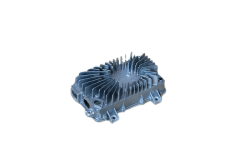
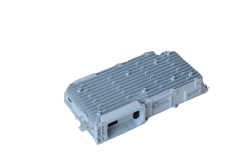
Fold edit this paragraph surface treatment
Aluminum phosphating
The effects of accelerators, fluorides, Mn2+, Ni2+, Zn2+, PO4 and Fe2+ on the phosphating process of aluminum were studied in detail by means of SEM, XRD, potential-time curves, and film weight changes. Studies have shown that guanidine nitrate has the characteristics of good water solubility, low dosage and rapid film formation, and is an effective accelerator for phosphating of aluminum materials. Fluoride can promote film formation, increase film weight, and refine grains; Mn2+, Ni2+ can significantly refine grains, make the phosphating film uniform and dense, and can improve the appearance of the phosphating film; when the concentration of Zn2+ is low, the film cannot be formed Or poor film formation, with the increase of Zn2+ concentration, the film weight increases; PO4 content has a great influence on the phosphatingfilm weight, and PO4 is increased. The content increases the weight of the phosphating film.
Alkaline Electropolishing Process for Aluminum
The research on the alkaline polishing solution system was carried out, and the effects of corrosion inhibitors and viscosity agents on the polishing effect were compared, and an alkaline solution system with good polishing effect was successfully obtained. Additives that improve longevity while also improving polishing results. The experimental results show that adding appropriate additives in NaOH solution can produce good polishing effect. The exploratory experiment also found that the reflectivity of the aluminum surface can reach 90% after DC electropolishing with NaOH solution of glucose under certain conditions, but further research is needed due to the unstable factors in the experiment. The feasibility of using DC pulse electropolishing method to polish aluminum under alkaline conditions was explored. The results show that the use of pulse electropolishing method can achieve the leveling effect of DC constant voltage electropolishing, but its leveling speed is slow.
Environmentally friendly chemical polishing of aluminum and aluminum alloys
Electrochemical Surface Strengthening Treatment of Aluminum and Its Alloys
The process, properties, morphology, composition and structure of ceramic-like amorphous composite conversion films formed by anodic oxidation deposition of aluminum and its alloys in neutral systems were preliminarily discussed. The process research results show that in the Na_2WO_4 neutral mixed system, the concentration of the film-forming accelerator is controlled to be 2.5~3.0g/l, the concentration of the complex film-forming agent is 1.5~3.0g/l, and the concentration of Na_2WO_4 is 0.5~0.8g/l , the peak current density is 6~12A/dm~2, and the weak stirring can obtain a gray series inorganic non-metallic film layer with complete uniformity and good gloss. The film thickness is 5~10μm, the microhardness is 300~540HV, and the corrosion resistance is excellent. The neutral system has good adaptability to aluminum alloys, and can form films well on various series of aluminum alloys such as rust-proof aluminum and forged aluminum.